
Do your customers really understand why they should choose your business over your competitors?
It’s a question worth asking, particularly if your business offers products or services that are similar to those available elsewhere. You might know exactly what makes your business different, but that doesn’t necessarily mean your customers see things the same way.
A well-defined value proposition helps bridge that gap by identifying who your customers are, what matters most to them and why your business is particularly well placed to meet their needs.
The good news is that you don’t need an entire day of workshops to get started. With a simple framework and around 15 minutes, you can begin developing a value proposition that gives your marketing, sales and wider business a stronger sense of direction.
What is a value proposition, and why does it matter?
A value proposition explains the value your business offers to a specific group of customers and what makes that value different from the alternatives available to them.
It’s not simply a catchy slogan, a company description or a list of product features. Rather, it’s the thinking behind why customers would choose to do business with you.
At its simplest, a useful value proposition answers four questions:
- Who are your customers? The specific people or businesses you’re trying to reach.
- What do they want to achieve? Their needs, challenges or goals.
- How does your business help? The product or service you provide and the problem it solves.
- Why should they choose you? The advantages that make your offering relevant and different.
Getting these answers right matters because customers don’t necessarily buy products or services for the reasons businesses think they do.
A manufacturer might focus its marketing on the technical specifications of its products, while customers are more concerned about reliability, delivery times and reducing production delays. Similarly, an accounting firm might promote its range of services when what its clients really value is dependable financial advice and support when making business decisions.
Understanding that difference can influence everything from how you position your business and develop your services to the messages you use in advertising and sales conversations.
Why your value proposition needs to evolve with your customers
Customer expectations don’t stand still, and neither should your value proposition.
The familiar comparison between Blockbuster and Netflix illustrates this particularly well. Blockbuster built its business around physical video rentals, while Netflix initially delivered DVDs by post before shifting towards streaming as technology and viewing habits changed.
The broader lesson isn’t simply that one business embraced technology and another didn’t. It’s that businesses need to keep asking what customers are actually trying to achieve, rather than defining themselves too narrowly by the products they currently sell.
For many businesses, this means recognising that customer expectations are changing, whether that’s greater convenience, flexible payment options, reliable delivery or easier access to support. These expectations will differ between industries, but the principle remains the same: what made your business attractive to customers five years ago may not be what matters most to them today.
Your value proposition should therefore reflect the needs of your customers as they are now, while remaining flexible enough to evolve as those needs change.
How to create your value proposition in 15 minutes
You don’t need specialist software or an elaborate strategy document for this first exercise. Start with a notebook, a few minutes of uninterrupted time and a willingness to think about your business from your customer’s perspective.
We’re going to use a straightforward five-part framework that helps you put the essential information into one place.
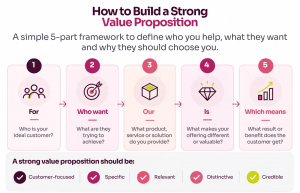
| Start with | What to identify |
|---|---|
| For | Your ideal customer |
| Who want | What that customer wants to achieve |
| Our | The product, service or solution your business provides |
| Is | What makes your offering different or particularly valuable |
| Which means | The practical benefit or outcome for the customer |
Let’s look at how this works with a hypothetical South African business.
A practical example: A business supplying industrial equipment
Imagine a company that supplies replacement machinery parts to manufacturers across South Africa.
Rather than defining its value purely around the products it sells, the business considers what its customers are actually trying to achieve.
| Framework | Example |
|---|---|
| For | Manufacturing businesses that depend on reliable production equipment |
| Who want | To minimise production delays caused by equipment breakdowns |
| Our | Industrial spare parts supply service |
| Is | A supplier offering reliable stock availability, knowledgeable technical support and dependable delivery |
| Which means | Maintenance teams can source the right parts more efficiently and reduce avoidable production downtime |
Notice that the focus moves away from simply selling spare parts to helping manufacturers keep their operations running.
That distinction matters because it gives the business something more relevant to communicate than a product catalogue or a generic promise of excellent service.
It also helps the marketing team understand which benefits deserve the most attention when creating campaigns, website content and sales materials.
Now create your own value proposition
With the example in mind, work through each part of the framework for your own business.
1. For: Identify your ideal customer
Begin by being specific about the customers you’re trying to attract. Describing your audience as “businesses in South Africa” or “anyone who needs our services” is unlikely to give you much direction.
Consider their industry, business size, location, buying responsibilities and the situations that lead them to need your product or service.
If you serve several distinct customer groups, it’s worth completing this exercise separately for each one. Different customers may buy the same product for very different reasons.
2. Who want: Understand what they’re trying to achieve
Think beyond the immediate product or service they’re looking for and consider the outcome they want.
A customer looking for a new CRM system probably doesn’t simply want more software. They may want better visibility of their sales pipeline, more reliable customer information or fewer administrative tasks for their team.
Try to identify the goal that matters most to your customer and keep your answer grounded in what you know about their needs.
3. Our: Define what you actually provide
This is where you describe your offering in straightforward terms. Avoid overly technical explanations or broad statements about everything your business is capable of doing.
Be specific enough that someone unfamiliar with your company would understand what you’re providing, whether that’s a specialist service, a physical product, a digital platform or a combination of different solutions.
4. Is: Explain what makes you different
This is often the most difficult part of the exercise because many businesses offer similar products, services or capabilities.
Think about why customers choose you rather than a competitor. Perhaps it’s your industry experience, specialist knowledge, delivery capability, service model or ability to solve a particular problem.
Be careful with claims such as “best quality”, “leading provider” or “excellent customer service” unless you can explain and demonstrate what those promises mean in practice.
Your differentiator should be something customers genuinely value, rather than something you simply want to say about your business.
5. Which means: Show the benefit to your customer
Finally, connect your offering to the result your customer wants.
This is where you explain the practical difference your product or service makes, whether that’s saving time, reducing risk, improving efficiency, creating new opportunities or making a difficult process easier.
It’s worth asking yourself whether the benefit is specific enough to matter to your ideal customer. If the statement could be used by almost any competitor, you may need to revisit your answers.
What makes a strong value proposition?
Once you’ve completed the exercise, read your answers together and consider whether they communicate something meaningful about your business.
A strong value proposition should be:
- Customer-focused: It starts with what your customers need, rather than what your business wants to sell.
- Specific: It identifies a particular customer or problem instead of trying to appeal to everyone.
- Relevant: It addresses a need that customers genuinely care about.
- Distinctive: It gives customers a reason to consider your business rather than another provider.
- Credible: It makes promises your business can realistically deliver.
One of the most common mistakes is trying to include every possible benefit and customer group in a single statement. Although this might feel more inclusive, it can leave your value proposition so broad that it doesn’t communicate anything particularly useful.
A more focused proposition helps you decide which opportunities are worth pursuing and where your marketing resources are likely to make the greatest difference.
Don’t develop your value proposition in isolation
Although this is a useful exercise to complete individually, your final value proposition should reflect the experience and knowledge of people across the business.
Your sales team may have a different understanding of why customers choose you, while customer service employees often hear about problems or frustrations that don’t reach senior management. Your operational teams may also recognise strengths or limitations that should influence the promises you make.
Ask a few people from different departments to complete the exercise independently, then compare the results.
Look for areas of agreement, but pay particular attention to where opinions differ. If your leadership team believes customers choose you because of price, while your sales team consistently hears that reliability is the deciding factor, that’s something worth investigating.
You can strengthen the exercise further by speaking directly to customers and reviewing feedback, enquiries and reasons for winning or losing business.
The aim isn’t simply to produce a statement everyone likes. It’s to develop a shared understanding of why customers buy from you and whether your business is delivering what they value.
How to use your value proposition in marketing
Once you’ve defined your value proposition, it should influence far more than the wording on your homepage.
It provides a useful reference point when making decisions about who to target, how to position your services and what your marketing needs to communicate.
For example, you can use it to:
- Improve your website messaging by focusing on customer needs and outcomes rather than lengthy descriptions of your business.
- Make campaigns more relevant by communicating benefits that matter to specific customer groups.
- Support your sales team with more consistent messages about why customers should choose you.
- Guide content development towards the questions, challenges and priorities your customers genuinely care about.
- Review your competitive positioning and identify where your business offers something different or particularly valuable.
Your value proposition should also be reviewed when your business introduces new services, targets different markets or notices changes in customer behaviour.
What matters is that it remains a practical guide to the decisions your business makes, rather than becoming another document that’s written once and rarely revisited.
Is your value proposition as strong as it could be?
Creating an initial value proposition is a useful starting point, but it’s worth testing whether your customers understand and value what you’re communicating.
You might discover that your business offers genuine advantages that aren’t coming through in your marketing, or that the benefits you’re emphasising are no longer the ones customers care about most.
The Marketing Centre’s Value Proposition Check is designed to help you take a closer look at your positioning and consider whether your offering is communicating the value your customers are looking for.
Explore our Value Proposition Check
If your business needs more support with its marketing strategy, positioning or growth plans, our experienced Marketing Directors can work alongside your leadership team to help connect your marketing decisions with your commercial objectives.
Book a discovery call to find out how The Marketing Centre can help.