Every business wants more leads, but generating enquiries is only part of the challenge. What really matters is whether those leads are likely to become customers.
It’s a familiar frustration. Marketing reports an increase in leads, but sales complains that too few are worth following up. Marketing believes its campaigns are working because people are responding, while sales sees a pipeline full of contacts who aren’t ready to buy, don’t have the budget or aren’t a good fit for the business.
Both teams may have valid concerns, but if they’re measuring success differently, it’s difficult to know where the real problem lies.
That’s why defining what makes a good lead is one of the most useful things you can do before investing more money in lead generation.
In this guide, we’ll explain how to identify a qualified lead, get your sales and marketing teams to agree on what good looks like, and put a simple process in place to improve lead quality over time.
What is a qualified lead?
A qualified lead is a potential customer who meets a set of criteria that makes them a worthwhile prospect for your business.
Those criteria will vary depending on what you sell, who you sell to and how customers make purchasing decisions. A company selling high-value industrial equipment, for example, will qualify leads very differently from a business offering subscription-based software.
The important thing is that both sales and marketing understand what makes someone worth pursuing, rather than treating every enquiry, website download or new CRM contact as an equally promising opportunity.
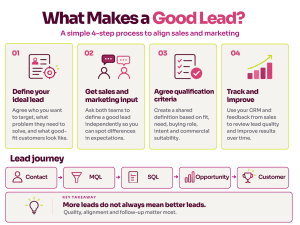
To make this easier, it helps to understand the stages a prospective customer might move through.
| Lead stage | What it means |
|---|---|
| Contact | Someone whose details are recorded in your CRM. They aren’t necessarily a qualified lead. |
| Lead | A contact who has shown interest or been identified as a potential customer. |
| Marketing Qualified Lead (MQL) | A lead who meets the agreed marketing qualification criteria and may be ready for further engagement. |
| Sales Qualified Lead (SQL) | A lead that sales has assessed and considers worth actively pursuing. |
| Sales opportunity | A potential sale being actively progressed, usually with an identified need and a defined next step. |
| Customer | Someone who has purchased your product or service. |
Not every business needs to use all these stages, and the definitions may differ between CRM systems. What matters is having an agreed process that reflects how your customers actually buy.
For instance, someone downloading an industry report might be interested in your expertise without having any immediate intention of buying. They could be a valuable future prospect, but passing their details straight to sales as a qualified lead could create unnecessary work and frustration.
By contrast, someone who matches your ideal customer profile, has a relevant business problem and requests a consultation may be much further along in their buying journey.
Understanding those differences is the foundation of a more effective lead generation strategy.
Why sales and marketing need to agree on lead quality
Sales and marketing are working towards the same commercial outcome, but their responsibilities and measures of success aren’t always the same.
Marketing may be focused on attracting the right audience, generating enquiries and nurturing prospective customers. Sales is usually more concerned with identifying genuine opportunities, progressing conversations and converting those opportunities into revenue.
Problems arise when there’s no agreement about where one team’s responsibility ends and the other’s begins.
Marketing might consider a lead qualified because someone has downloaded a guide, attended a webinar or engaged with several emails. Sales might only consider that person qualified once their need, budget and buying intentions have been established.
Neither definition is necessarily wrong, but the business needs to agree on which criteria determine when a lead is ready to move forward.
When sales and marketing share a common definition, several things become easier:
- Better targeting: Marketing can focus campaigns on the types of customers sales is most likely to convert.
- More useful lead handovers: Sales receives better information about prospects and why they may be interested.
- Less wasted effort: Teams spend less time pursuing enquiries that aren’t suitable or ready.
- More meaningful reporting: The business can see whether lead generation is creating genuine sales opportunities, rather than simply increasing enquiry volumes.
- Better feedback: Sales can tell marketing which leads are converting and where qualification needs to improve.
Achieving this alignment doesn’t necessarily require new technology or additional marketing spend. It often begins with a conversation between the people responsible for generating leads and the people expected to convert them.
How to define a qualified lead for your business
The following four-step exercise will help you create a shared definition of a good lead and establish how that definition should be used.
What you’ll need: Access to your recent lead and sales data, a notebook or shared document, and time with your marketing and sales leaders.
Time required: Allow approximately two to three hours, including preparation and a joint discussion.
Step 1: Define your ideal lead
Start by writing down what a good lead looks like from the perspective of the business.
Think about the customers you most want to attract, particularly those who are profitable to serve, value what you offer and are likely to benefit from your products or services.
Try to be specific rather than describing every organisation or individual who could potentially buy from you.
Some useful questions include:
- What industries or markets do your ideal customers operate in?
- What size businesses are you best equipped to serve?
- Which job roles are typically involved in researching, recommending or approving a purchase?
- What problems are customers trying to solve?
- What usually triggers them to start looking for a solution?
- What budget or purchasing requirements are relevant?
- How long does the buying process typically take?
- What characteristics do your most successful existing customers have?
It’s worth reviewing customers you’ve already won, rather than relying entirely on assumptions about who you would like to attract.
Look for patterns in the types of organisations that buy from you, the reasons they chose your business and how they first became aware of your offering.
The aim is to develop a realistic picture of the customers you’re most likely to help and successfully convert.
Step 2: Ask sales and marketing to define a good lead independently
Next, ask your sales and marketing leaders to complete the same exercise separately.
It’s important not to share your answers beforehand, because you want to understand how each team currently thinks about lead quality.
Marketing may place greater emphasis on customer characteristics, engagement with campaigns and demonstrated interest. Sales may focus on purchasing authority, the urgency of the requirement and whether a prospect is ready to have a commercial conversation.
This difference is useful because it reveals where the two teams may have different expectations.
For example, marketing could be generating enquiries from exactly the right industries, but sales may find that the individuals responding don’t have sufficient influence over purchasing decisions.
Alternatively, sales might be rejecting leads that aren’t ready to buy immediately, even though those contacts could become valuable opportunities with the right nurturing.
Understanding these perspectives helps you identify whether the challenge lies in targeting, qualification, timing or the handover process.
Step 3: Agree on a shared definition and handover process
Bring everyone together to compare their answers and develop a practical definition that both teams are comfortable using.
The goal isn’t to decide who has been right or wrong about lead quality. It’s to agree on criteria that help the business identify promising opportunities consistently.
Your final definition might include:
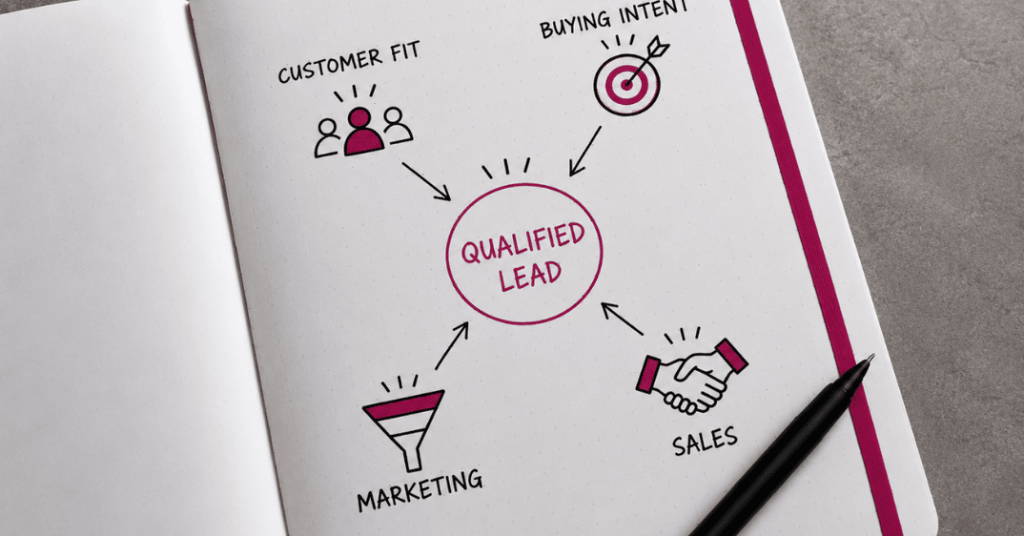
- Customer fit: Does the person or organisation match your ideal customer profile?
- Business need: Is there a relevant problem your product or service can solve?
- Buying involvement: Is the contact involved in the decision, or can they connect you with someone who is?
- Level of interest: Have they demonstrated meaningful interest beyond a single low-commitment interaction?
- Purchase timing: Is there an immediate requirement, or is this a longer-term opportunity?
- Commercial suitability: Are their likely requirements and budget broadly compatible with what you offer?
Not every criterion needs to be confirmed before a lead enters your pipeline. In fact, expecting marketing to establish every detail before sales engages may result in valuable opportunities being overlooked.
Instead, agree on which information marketing should capture, which questions sales should investigate and what happens when a lead isn’t ready to move forward.
For example, a prospect may fit your ideal customer profile but not be ready to buy for another six months. Rather than discarding them, marketing could continue sharing relevant information until there’s a stronger reason for sales to reconnect.
You should also agree on practical details such as who receives new qualified leads, how quickly they should be followed up and how sales will report back on their quality.
This gives both teams a process they can actually use rather than simply agreeing on a definition that sits in a document.
Step 4: Put your definition into practice and review the results
Once you’ve agreed on what makes a qualified lead, communicate the definition to everyone involved in generating, qualifying and following up opportunities.
Ideally, these criteria should also be reflected in your CRM, so that lead information, qualification status and ownership can be recorded consistently.
You might use a combination of contact properties, lifecycle stages, lead statuses and agreed qualification questions, depending on the system your business uses.
Your CRM should help people understand where each prospect sits in the process and what needs to happen next, rather than simply becoming a database of names.
Just as importantly, give sales a straightforward way to provide feedback on the leads they receive.
If certain campaigns repeatedly produce leads that aren’t a good fit, marketing needs to know. If sales is successfully converting prospects from a particular industry or customer segment, that insight should influence future targeting and investment.
Set aside time for both teams to review the results together and make adjustments as customer behaviour, business priorities and market conditions change.
How do you know if your lead generation is improving?
Once you’ve defined a qualified lead, the next step is to look beyond the total number of leads being generated.
A campaign that produces 200 enquiries isn’t necessarily more successful than one generating 40. If the smaller group contains more suitable prospects who go on to become customers, it may deliver greater commercial value.
This is why lead generation reporting should include measures of both lead quality and sales progression.
Some useful metrics to monitor include:
- Lead-to-MQL conversion rate: The proportion of leads that meet your agreed marketing qualification criteria.
- MQL-to-SQL conversion rate: The proportion of marketing-qualified leads that sales accepts as suitable prospects.
- Lead-to-customer conversion rate: The proportion of leads that eventually become paying customers.
- Cost per qualified lead: How much you spend generating leads that meet your qualification criteria.
- Sales pipeline generated: The value of opportunities created from marketing activity.
- Lead response and follow-up: How quickly qualified leads receive attention and whether the agreed next steps take place.
You don’t need to measure everything immediately, particularly if your current reporting is limited. Start with the information you can collect reliably and build from there.
What matters is using the data to understand where opportunities are being lost.
If marketing is generating plenty of leads but very few qualify, your targeting or campaign messaging may need attention. If leads qualify but don’t progress after being handed to sales, the challenge might involve follow-up, sales conversations, qualification criteria or the offer itself.
Looking at the full journey gives you a much more useful picture than measuring campaign response rates in isolation.
What if you’re getting leads but not enough sales?
This is where many businesses make an expensive mistake.
When sales aren’t meeting their targets, the immediate response is often to generate more leads. That might mean increasing advertising budgets, launching another campaign or investing in additional lead generation tools.
Sometimes more leads really are the answer. But before increasing your spending, it’s worth understanding what’s happening to the enquiries you’re already receiving.
Are the right people responding to your marketing? Are they being qualified consistently? Is there a clear follow-up process, and does anyone know which activities are creating actual sales opportunities?
A business may discover that it doesn’t need twice as many leads. It needs better targeting, more effective nurturing, improved communication between sales and marketing, or a more consistent process for moving prospects through the pipeline.
That’s why an effective lead generation strategy needs to consider the full customer journey, from understanding who you’re trying to reach through to converting interest into business.
For further reading, explore our guides to the five fundamentals of effective B2B lead generation and how to land the leads your business needs.
Need help generating better leads?
If your business is investing in lead generation but struggling to attract the right prospects or convert enquiries into sales, it may be time to take a closer look at your marketing approach.
At The Marketing Centre, we help businesses understand what’s working, identify where opportunities are being lost and develop marketing strategies that support their commercial goals.
Our experienced Fractional Marketing Directors can work alongside your leadership, sales and marketing teams to improve targeting, agree on lead qualification criteria, review performance and ensure marketing activity is supporting the wider sales pipeline.
Where businesses need additional hands-on support, our Activation Services can help put those plans into practice through campaign delivery, content, digital marketing, CRM, marketing automation, lead nurturing and reporting.
Whether the challenge is attracting more suitable prospects, improving lead quality or making better use of the opportunities you already have, the starting point is understanding where your current approach could work harder.
Let’s talk about how to make your lead generation more effective.
Book a discovery call with The Marketing Centre to discuss your lead generation challenges and where experienced marketing support could make a difference.
You can also explore our Marketing 360 Assessment for a broader review of your marketing strengths, challenges and priorities.