
Should you outsource your marketing to specialists, build an in-house team or find a way to combine the two?
It’s a question many business owners face as their companies grow, particularly when marketing begins to demand more time, expertise and resources than they have available internally. You might expect The Marketing Centre to recommend outsourcing everything to marketing experts, but we believe the answer is a little more nuanced than that.
Marketing influences almost every part of a business, from the customers you want to attract and the products you develop to how you communicate your value, build relationships and generate revenue. Given how closely these decisions are connected to the overall direction of your business, handing over complete responsibility for marketing to an external supplier rarely makes sense.
After all, nobody understands your business, your customers and your commercial ambitions quite like you do. That doesn’t mean you need to personally manage every campaign, oversee every social media post or become an expert in every marketing discipline. In fact, trying to do everything internally can sometimes hold a business back, particularly when your team is already stretched or lacks specialist experience.
The challenge is finding the right balance between keeping ownership of your marketing strategy and bringing in the expertise needed to deliver it effectively.
Why marketing should remain part of your business
Marketing is too important to operate separately from the rest of your business. Decisions about your target customers, competitive positioning, pricing, products and growth opportunities all influence how marketing should work, which is why senior leadership needs to remain actively involved in setting its direction.
When marketing is closely connected to the business, it’s much easier to make decisions that support commercial priorities rather than simply keeping campaigns running. Your sales team can share what they’re hearing from customers, your operational teams can identify opportunities or limitations, and your leadership team can make informed decisions about where marketing investment should go.
There are several good reasons to retain marketing ownership within your business:
- A stronger understanding of customers: Your people have direct experience of customer needs, buying behaviour and the challenges customers face.
- Better alignment with business objectives: Marketing decisions can be made alongside sales, financial and operational priorities.
- Greater accountability: Someone within the business remains responsible for marketing performance and investment.
- More consistent communication: Marketing can respond to changes in the business and work closely with other departments.
For smaller businesses, this responsibility often sits with the owner or CEO, particularly in the early stages when there isn’t enough work or budget to justify a dedicated senior marketing appointment. Over time, however, the demands of marketing tend to increase, and what once felt manageable can become another substantial responsibility competing for the owner’s attention.
This is where many businesses find themselves in a difficult position. They recognise that marketing needs more direction, but they’re not necessarily ready to employ a full-time Marketing Director. They might already have a capable marketing coordinator or a small team managing everyday activities, yet still need someone with the experience to develop the strategy, challenge decisions and ensure that marketing investment contributes to growth.
Bringing in experienced marketing leadership doesn’t mean giving up control. It means having someone who can work alongside the people running the business, understand its priorities and take responsibility for turning those priorities into a marketing strategy that can realistically be delivered.
The benefits and limitations of keeping marketing in-house
There are good reasons why businesses choose to develop an internal marketing team. Employees who work closely with the business every day become familiar with its customers, products, culture and the challenges faced by colleagues in other departments. That knowledge can be particularly valuable when marketing requires regular collaboration with sales, operations and customer-facing teams.
An internal team can also respond quickly when something changes and build valuable knowledge over time about what works for the business. Where there’s a consistent volume of work, having dedicated employees available can make practical and financial sense.
The main advantages of in-house marketing include:
- Business knowledge: Employees develop a detailed understanding of your products, services and customers.
- Day-to-day availability: Your team is accessible when priorities change or urgent work arises.
- Closer collaboration: Marketing can work directly with sales, operations and management.
- Long-term continuity: Knowledge, relationships and experience remain within the business.
However, marketing has become an increasingly broad discipline, and few businesses can afford to employ someone with deep expertise in every area.
A marketing manager might be highly capable when it comes to campaign planning and coordination but have limited experience in marketing automation, paid advertising or website development. Equally, a talented digital marketer may understand the platforms and tools extremely well without yet having the commercial experience needed to lead marketing at a strategic level.
This isn’t necessarily a reflection of the quality of the people you’ve hired. It simply means that the skills required to manage marketing strategy aren’t always the same as those needed to deliver the work.
Businesses also need to consider the ongoing cost and commitment involved in recruitment. Hiring permanent employees makes sense when there’s sufficient work to justify those roles, but it becomes less practical when you need a particular skill for a few months or when your requirements change from one campaign to the next.
For many growing South African businesses, the question is therefore not whether an in-house team is better than outsourced marketing, but which responsibilities are best managed internally and where external expertise could make the greatest difference.
When does outsourcing your marketing make sense?
Outsourcing can be particularly useful when your business has a clear idea of what it wants to achieve but doesn’t have all the skills or capacity needed to make it happen.
It doesn’t necessarily mean handing your entire marketing function to an agency. You might bring in a specialist for a particular project, outsource an ongoing activity or work with additional marketing professionals who support your existing team.
There are several situations where outsourcing can be particularly valuable.
1. When you need specialist marketing skills
Marketing involves a wide range of disciplines, and employing an experienced specialist in every area isn’t always realistic. Your team might be comfortable managing campaigns and everyday communications but need additional expertise in areas such as:
- Digital advertising and campaign optimisation
- Website development and search marketing
- CRM systems and marketing automation
- Content creation, design and video production
- Email marketing, analytics and reporting
Outsourcing allows you to bring in the relevant expertise without committing to permanent appointments for skills you may only need at particular times.
2. When your existing team is stretched
Sometimes the challenge isn’t a lack of skills but simply the volume of work that needs to be done.
Your marketing team might have a well-developed plan, with campaigns, projects and priorities already agreed, yet struggle to find enough hours in the week to deliver everything. Content gets delayed, campaigns take longer to launch and important improvements are repeatedly pushed aside to deal with more immediate demands.
Bringing in additional implementation support can relieve some of that pressure, allowing your existing employees to concentrate on their responsibilities while ensuring that planned marketing activities keep moving forward.
3. When you’re launching something new
Entering a new market, launching a product or introducing a different service can create marketing requirements your team hasn’t dealt with before.
An external specialist who has experience with similar projects can help your business prepare, avoid common mistakes and manage the additional workload. This can be particularly useful when the requirement is temporary and doesn’t justify another permanent employee.
4. When you want to develop your existing team
Outsourcing isn’t only about getting someone else to do the work. It can also be an opportunity to develop the skills and confidence of your own employees.
When external specialists work alongside an internal marketing team, they can provide practical guidance, introduce new processes and share knowledge that continues to benefit the business after the project has finished.
This is particularly useful when you have promising junior marketers who need experienced support and mentoring rather than replacing.
5. When you need more flexibility
Marketing requirements rarely remain the same throughout the year. A business might need considerable support during a product launch or campaign period, followed by a quieter phase focused on reporting, optimisation and customer retention.
Using outsourced expertise means you can adjust the skills and capacity available to your business as your requirements change, rather than building your permanent team around periods of unusually high demand.
What are the disadvantages of outsourcing marketing?
While outsourcing offers many benefits, it isn’t automatically the right solution for every business.
External providers need time to understand your customers, commercial objectives and the way your business operates. Without that understanding, even technically good marketing work can fail to deliver what the business actually needs.
There are also practical challenges worth considering:
- Limited business knowledge: External specialists may initially lack the understanding that comes from working within your business every day.
- Communication gaps: Projects can lose momentum when responsibilities, expectations and approval processes aren’t clearly defined.
- Disconnected activities: Different agencies or freelancers may focus on their individual deliverables without considering how everything fits into the wider marketing strategy.
- Loss of knowledge: Important processes and information can leave with a supplier if they haven’t been documented or shared with your internal team.
These risks don’t mean outsourcing should be avoided. They simply highlight why it’s so important to have someone responsible for the overall marketing direction, whether that’s an experienced internal Marketing Director or a fractional leader who works closely with your business.
Where does a Fractional Marketing Director fit in?
One of the most common assumptions businesses make is that their only options are to employ a full-time Marketing Director or outsource marketing to an agency. In reality, there’s another approach that can provide experienced internal leadership without requiring a permanent senior appointment.
A Fractional Marketing Director works within your business on a part-time basis, becoming part of your leadership team and taking responsibility for marketing strategy, priorities and performance. Rather than operating as an external consultant who provides recommendations and then moves on, they remain actively involved in the business, working with its people and helping to ensure marketing supports commercial objectives.
This distinction matters because senior marketing leadership involves much more than producing a strategy document. An experienced Marketing Director should be able to challenge assumptions, identify opportunities, make decisions about investment and help the business understand which activities are genuinely contributing to growth.
At The Marketing Centre South Africa, our Supercharged Fractional Marketing approach gives businesses access to experienced marketing leadership, supported by the expertise of a wider network.
This can work particularly well when:
- A business owner wants to step away from managing marketing personally but remain involved in strategic decisions.
- An existing marketing team needs more senior direction, mentoring and accountability.
- A growing company requires Marketing Director-level expertise without appointing someone full-time.
- Several external specialists or agencies need experienced leadership to coordinate their activities and keep everyone working towards the same objectives.
The important point is that fractional leadership doesn’t replace marketing ownership within the business. It brings experienced marketing leadership into the business, where it can contribute directly to the decisions and activities that matter.
What about actually getting the marketing done?
Even with experienced leadership and a well-developed strategy, businesses can still struggle to deliver everything they’ve planned.
A Marketing Director may have identified the right priorities and agreed on the activities needed to achieve them, but that doesn’t automatically mean the business has the resources to carry them out. When the internal team is small or already working at capacity, implementation can become the point where otherwise sensible marketing plans begin to stall.
This is where The Marketing Centre’s Activation Services can provide additional support.
Our Activation Team offers hands-on marketing expertise to help businesses deliver campaigns, manage digital activities, develop content, improve CRM processes and carry out the day-to-day work that supports their strategy.
Depending on what the business needs, the team can:
- Work alongside an existing Marketing Director to deliver agreed marketing activities.
- Provide additional capacity when an internal team has more work than it can manage.
- Bring specialist skills into the business without requiring permanent recruitment.
- Support and mentor less experienced marketers as they develop their capabilities.
- Help businesses without an established marketing department access experienced implementation support.
For companies already working with a Fractional Marketing Director, Activation Services can help connect strategic direction with the specialist expertise needed to deliver it. For those with established internal leadership, the team provides additional support without changing who is responsible for the overall strategy.
This means businesses can strengthen their marketing capability without necessarily expanding their permanent headcount, while ensuring their existing employees remain involved and continue developing their skills.
In-house vs outsourced marketing: How do you choose?
There’s no single marketing structure that works for every business. The right approach will depend on your growth stage, commercial objectives, available budget and the experience already within your organisation.
Before deciding whether to recruit or outsource, it’s worth asking a few practical questions:
- Who’s responsible for your marketing strategy? Do you have someone with the experience and authority to connect marketing decisions to business objectives?
- What can your current team deliver confidently? Understanding your existing strengths will help you avoid outsourcing work that can be managed effectively internally.
- Where are the biggest gaps? You might need more senior direction, specialist marketing expertise or additional capacity to deliver existing plans.
- Is the work ongoing or project-based? Permanent recruitment may make sense for consistent everyday requirements, while outsourcing may be more practical for specialist or temporary work.
- How will you measure success? Whether marketing is managed internally or externally, there should be clear expectations about what needs to be achieved and how performance will be assessed.
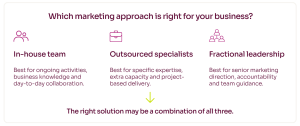
In many cases, the most effective solution is a combination of the two. A business might retain a marketing coordinator or small internal team to manage everyday activity, bring in a Fractional Marketing Director to provide senior leadership and use specialist support when particular skills or additional capacity are required.
For other businesses, employing a larger permanent marketing team may be entirely appropriate. What matters is building the right structure around the work that needs to be done, rather than assuming one model is always better than another.
So, should you outsource your marketing?
Outsourcing marketing can be an excellent decision, provided it supports rather than replaces the connection between marketing and the wider business.
The strongest approach is usually one that keeps strategic ownership close to the leadership team while ensuring there is sufficient experience, specialist expertise and capacity to deliver the work. Sometimes that means building a larger internal department, while in other cases it means combining a smaller team with fractional leadership and outsourced implementation support.
Ultimately, the question isn’t whether your marketers should be permanent employees or external specialists. It’s whether your business has the right people, working in the right roles, to make marketing more effective and support sustainable growth.
At The Marketing Centre, we help businesses build that capability through Supercharged Fractional Marketing and hands-on Activation Services, bringing together experienced marketing leadership and practical implementation support in a way that suits their needs.
Book a discovery call to explore what the right marketing approach could look like for your business.